Light
Shadow
Human Form
Viewer questioning what they see, and what they know........
Wednesday, 31 March 2010


A. Balasubramaniam



"I like to be called a person who creates art, and not merely a painter, printmaker or a sculptor."
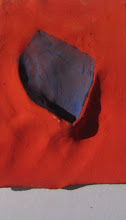
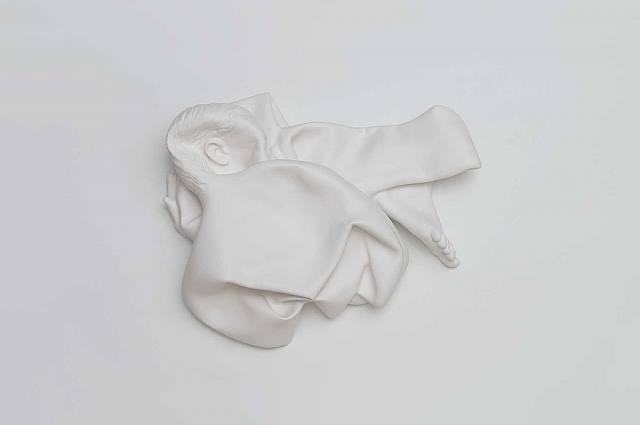
Balasubramaniam’s latest works are a play of shadows through which he questions the viewer’s belief in the unseen and the unknown – encouraging them to query their own consciousness. After stripping down a form to its bare minimum, Balasubramaniam allows it to grow again through a series of shadows – although seen, intangible to the sense of touch. Each form and its multiple shadows share their own camaraderie with the element of light. With some appearing darker and deeper than others, the notion of transcendental infinity is also established.
“Despite the strong visual affirmation involved in witnessing Bala’s works, we are nevertheless challenged to believe what we see. Our sense of perception, of reality, is questioned and at times evokes a contradictory realization” says Deepak Talwar of Talwar Gallery, Delhi and New York.
Born in Tamil Nadu in 1971, Balasubramaniam received his Bachelor’s degree in fine arts from the Government College of Arts, Chennai, in 1995. In 1998, he studied printmaking at EPW Edinburgh, UK, after which he pursued his love for the genre at the Universitat fur Angewandte Kunste in Wien, Austria. He has travelled extensively and exhibited in France, Spain, Egypt, Japan, Malaysia, Finland, Norway and USA. Amongst his solo shows are ‘(In)Visible’ at Talwar Gallery, New Delhi, in 2007; Talwar Gallery, New York, in 2007; ‘(Desi)re’ at Talwar Gallery, New York, in 2005; ‘Transition and Transformation’ at the Fine Arts Museum, University of Massachusetts, Amherst, also in 2005; and Talwar Gallery, New York, in 2004. His most recent group endeavors include ‘Freedom 2008 – Sixty Years after Indian Independence’ at the Centre for International Modern Art (CIMA), Kolkata, in 2008; ‘The Inverted Tree’ at Gallery Threshold, New Delhi, in 2005; ‘Indian Summer’ at the Ecole des Beaux Arts, Paris, also in 2005; and ‘Solitude’ at the India Habitat Centre, New Delhi, in 2003.
The artist lives and works in Bangalore.
Thursday, 25 March 2010
Nick Veasey
25 March 2010: From a Boeing 777 to a Mini Cooper and a even a fruit bat, Brit artist and X-ray boffin Nick Veasey has captured them all. Veasey uses a cargo scanner to make the images, some of which cost thousands of pounds to produce


Sunday, 14 March 2010
for Brulafu - Art Dubai 2010 Art Fair

Art Dubai, Courtesy Art Dubai
Now in its fourth year, Art Dubai has become a defining platform for contemporary art practice across the Middle East region. Highlights of Art Dubai 2010 will include the return of the acclaimed Global Art Forum, the second annual Abraaj Capital Art Prize; “The Poetry of Time”, a museum quality exhibition curated by Van Cleef & Arpels; Art Park and Contemparabia 2010. In addition, Art Dubai has invited not-for-profit arts organization Bidoun Projects to curate its program of special projects highlighting the importance of collaboration in the region.
Earlier this year, Art Dubai’s third edition attracted an audience of more than 14,000 visitors from across the Middle East, South Asia and beyond, including leading curators, museum directors, artists, 80 museum groups and more than 300 international journalists. Online video and multimedia content showcasing highlights of Art Dubai’s successful 2009 fair, including the Abraaj Capital Art Prize and key panels of the Global Art Forum are now available for viewing.
Art Dubai 2010 is held in partnership with private equity group Abraaj Capital and continues to enjoy support from its sponsors Van Cleef & Arpels and Jumeirah Hotels & Resorts. Based at the stunning beachside Madinat Jumeirah Resort, Art Dubai 2010 offers visitors the most extensive program of contemporary art exhibitions and events to date.
John Martin, Director and Co-Founder of Art Dubai said, “Over the past three years, Art Dubai has created a critical platform for current art practice in the Middle East, setting the business of art within a context that is intelligent, stimulating and relevant. Through innovative collaborations with world-class galleries and arts organizations we have established Art Dubai as an date not to be missed on the international art calendar, offering a unique vantage point for collectors to discover the most innovative younger galleries and artists alongside established names from around the world.

Yamini Nayar, Underfoot And Overhead - The Saatchi Gallery

Yamini Nayar works with installation and architecture as photography, creating imagined, psychologically laden interiors from found and discarded materials. These installations are destroyed after the work is photographed, so that the photographic image serves as a stand-in for the original work. In representing invented spaces as still images, any sense of scale is concealed from the audience. The interiors appear destroyed by acts of nature. In Underfoot and Overhead a dishevelled staircase falls precariously from a doorway with a thread of foliage hanging over the darkened entrance. Once inside, a single light-bulb appears to illuminate a darkened room. The work takes its name from a Rudyard Kipling poem.
Subscribe to:
Posts (Atom)